Guide to Handmade Bracelets and Stones for Making Bracelets
In this guide you will find useful information both for choosing ready-made handmade bracelets and for buying stones for making handmade bracelets. Many people look for finished bracelets for personal use, gifts or resale, while others prefer to buy the materials and create their own designs. Both options are valid, and the best choice will depend on the type of customer, the time available, the budget and the result you want to achieve.
At UniArt, we work both with ready-made handmade natural stone bracelets and with stones for bracelets, beads and findings for those who want to create their own pieces. That is why, in this guide, we have brought together practical advice to help you choose more confidently in each case.
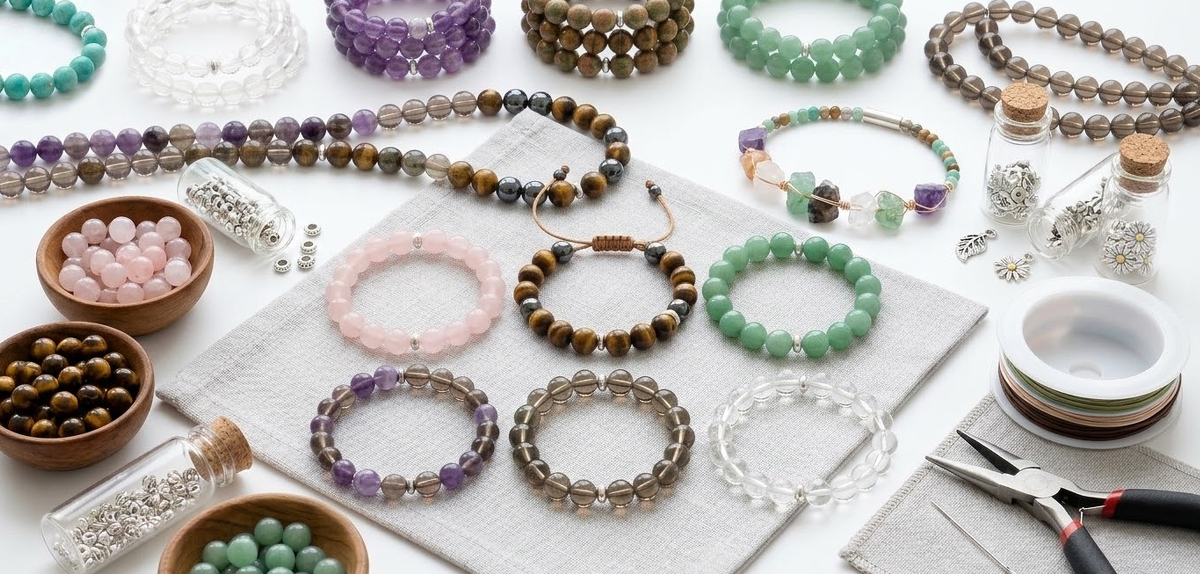
Buying handmade natural stone bracelets
Within the world of handmade bracelets, one of the most sought-after styles today is natural stone bracelets. These pieces are highly valued both for their appearance and for the variety of minerals, colours and meanings they can offer. When buying a handmade bracelet, it is worth looking not only at the stone itself, but also at the type of assembly, the fastening, the size and the use it is intended for.
Types of handmade bracelets according to their assembly
Handmade natural stone bracelets can be made in different ways. Some are assembled with cord, others with elastic thread, and others include metal clasps. Cord bracelets are often a very good option when they are adjustable, as they adapt more easily to different wrist sizes. By contrast, bracelets with a fixed clasp require the size to be checked more carefully, as they do not always fit everyone equally well.
Elastic bracelets are among the most popular because of their comfort and ease of use. In general, they adapt better to different wrists, although on very small wrists they may sit a little loose. Adjustable bracelets, on the other hand, offer a good solution when flexibility of size is needed, although they usually leave a small part of the cord visible, which some people find less comfortable. With this type of model, it is always advisable to check the minimum and maximum size before buying.
What to consider before choosing a handmade bracelet
When buying handmade natural stone bracelets, it is important to take into account each person’s preference, wrist size and how the bracelet will be worn. With adjustable models, it is worth checking the minimum and maximum measurements, while with fixed-clasp or less flexible models it is advisable to check the overall diameter or length of the piece more carefully. In elastic bracelets, besides the design, the quality of the elastic and the assembly also plays an important role.
It is also worth remembering that, although these are very popular and pleasant products to wear, both the cord and the elastic, as well as the metal components, can deteriorate with use. This is particularly noticeable in summer, when bracelets are worn more often and are more exposed to sea water, swimming pools, sweat, perfumes, cosmetics or cleaning products. These factors can affect both costume jewellery metal parts, the cords, the elastics and even the shine of some stones.
Use, care and durability
Bracelets assembled with cord usually offer good resistance, whereas with elastic bracelets it is advisable to check the condition of the elastic regularly and replace it before it deteriorates too much. This is a simple maintenance task that helps to prevent breakage and the loss of beads or stones. In general, it is advisable not to wear this type of bracelet continuously and to avoid contact with the beach, swimming pools or chemicals in order to prolong its lifespan.
Within the range of handmade bracelets, you can find both pieces assembled by local artisans and imported models with a very good balance between design and price. At UniArt, we work with a range of imported handmade bracelets and also with some models that we assemble here in Spain. In both cases, what matters is selecting bracelets with good finishes, well-presented materials and an assembly suitable for retail sale or everyday wear.
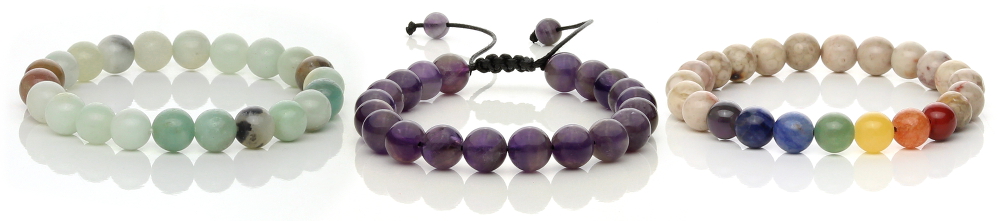
Stones for making handmade bracelets
As well as buying ready-made handmade bracelets, many people prefer to buy stones for bracelets and create their own designs. At UniArt, we also work with materials for this purpose, so that both shops and private individuals can assemble their own bracelets according to their style, budget and creativity.
Why make your own handmade bracelets
For many shops and professionals, buying stones for making handmade bracelets can be a very interesting option. The materials are usually more economical than buying the bracelet already finished, they allow spare time to be used more effectively, and they help to create exclusive designs with better margins and less direct competition. When a shop makes its own bracelets, it can decide on the style, the combinations, the type of stone and the final finish, making it easier to offer more personal and distinctive pieces.
There are also many people who want to make their own bracelets as a hobby, as a creative activity or even as a way to relax. What is more, a handmade bracelet can become a far more personal and special gift. That is why interest in stones for bracelets, mineral beads and findings continues to grow among both professionals and private individuals.
How to choose stones for bracelets
When choosing stones for bracelets, it is worth first looking at the type of material. There are natural stones, synthetic stones, and also natural stones that have been dyed or colour-enhanced. For bracelets intended for frequent use, we normally recommend opting for natural stones with their natural colour, as this reduces the risk of the colour deteriorating through use, friction or repeated contact with water.
This recommendation is particularly important for bracelets that are going to be worn daily. Hands are washed frequently, bracelets are often worn at the beach or swimming pool in summer, and over time more sensitive materials can suffer. Choosing natural stones with their natural colour helps the piece to keep its appearance for longer.
Bead size and comfort
It is also important to choose the bead size carefully. 6 mm and 8 mm beads are usually the most commonly used for bracelets, and 4 mm beads can also work well in finer or more delicate designs. By contrast, beads that are too large are usually less comfortable, while very small beads can make assembly and threading more difficult.
For anyone starting to make handmade bracelets, 6 mm and 8 mm beads are usually a good choice because they are comfortable to work with and offer a very good balance between visual presence and ease of assembly.
Elastic, cord and number of beads
If you are going to make elastic bracelets, it is advisable always to use good-quality elastic and to pass the cord through double for greater strength. This helps to improve the durability of the bracelet and reduces the risk of breakage with use. In this type of work, it is also advisable to choose the thickness of the assembly material carefully according to the size of the bead hole.
Many customers ask us how many beads are needed to make a bracelet. As a general guideline, a standard-size bracelet usually uses around 28 to 30 beads of 6 mm, while for an 8 mm bracelet it is more usual to work with 22 to 24 beads. If the bracelet includes spacers, separators or other components, the number of beads should be reduced according to the length those components take up, so that the inner diameter or final measurement of the bracelet remains suitable.
As a practical reference, for a standard bracelet intended for a small or medium wrist, an inner measurement of approximately 15 to 17 cm is usually used. If the design is intended for larger wrists, the final size should be increased and the number of beads or components adjusted accordingly.
It is also worth bearing in mind that a strand of natural stone beads of around 38 to 40 cm, which is a common length, is usually enough to make two bracelets with a few beads left over. This can vary slightly depending on bead size and on whether spacers, charms or other decorative elements are added.
In the standard-hole beads that we usually work with, the hole generally measures approximately 10% of the bead diameter. For that reason, when working with cord, elastic or wire, it is always advisable to check that the chosen thickness passes through with enough clearance, especially in double-threaded designs or with smaller beads.

How to combine colours and meanings
When creating handmade bracelets, stones can be chosen according to different criteria. Some people prefer to combine colours, while others are guided more by the traditional meaning of each mineral. If you want to create a bracelet aimed at a particular chakra, you can combine stones with colours associated with that chakra. If the aim is to make a protection bracelet, you can mix different stones traditionally associated with that kind of esoteric use.
Stones for bracelets offer many possibilities for combination, because natural colours usually blend very well with one another. In summer, brighter tones such as pinks, blues or greens tend to be more popular, while in winter warmer or deeper colours such as browns, reddish tones or naturally inspired combinations usually work better. In addition to bracelets, these materials can also be used to create bracelet and necklace sets, which often work very well both for personal use and for sale in shops.
Which option to choose: ready-made bracelets or materials to assemble them
The best option will depend on each case. Buying ready-made handmade bracelets is a comfortable and quick solution, especially when you want immediate variety, replenishment or direct retail sale. By contrast, buying stones for making bracelets allows you to customise designs, create exclusive pieces and obtain a better margin if you have time available for assembly.
In both cases, what matters is choosing the materials well, understanding the type of customer the piece is intended for, and opting for designs or combinations that are attractive, comfortable and well presented. Whether you are looking for finished bracelets or prefer to make your own creations, at UniArt you will find options designed for shops, professionals and people interested in natural stones and handmade costume jewellery.